What Separates High-Performing Teams?
Many leaders I work with have invested significantly in the people on their teams. They have hired well. They have developed their people. They have worked hard to build the right culture. And yet performance stays stubbornly average. Deadlines slip. Accountability is inconsistent. The same conversations happen in meeting after meeting without resolution.
When that pattern shows up, the instinct is almost always the same: we need better people, or we need to develop the people we have. Both of those may be true. But in my experience, neither is usually the root cause. The root cause is often a design challenge.
Teams Fail by Default, Not by Accident
Richard Hackman spent decades studying what actually makes teams effective. His conclusion is counterintuitive for most leaders: the biggest driver of team performance is not the quality of the individuals on the team. It is the conditions surrounding them.
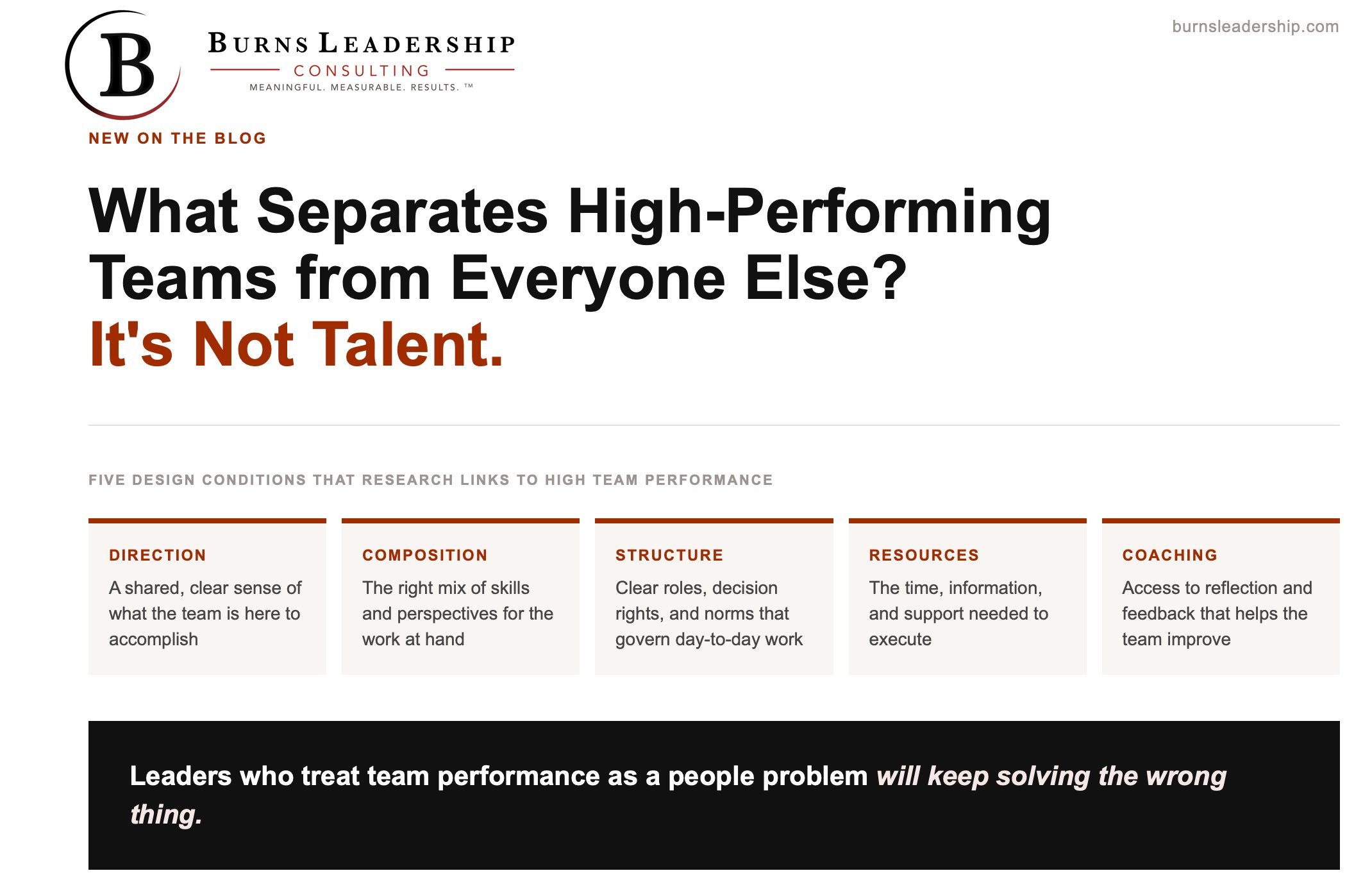
Hackman identified five design conditions that high-performing teams consistently have in place:
A compelling direction: a shared, clear sense of what the team is trying to accomplish and why it matters.
The right composition: the right mix of skills, perspectives, and working styles for the task at hand.
Clear structure: defined roles, decision rights, and norms that govern how the team operates day to day.
Adequate resources: the information, tools, time, and organizational support to do the work.
Coaching and support: access to the kind of reflection and feedback that helps teams learn and improve over time.
When those conditions are in place, even average performers tend to produce above-average results. When they are missing, even talented people underperform, because the system they are operating in is working against them.
The Numbers Make the Case
Before we talk about what to do differently, it is worth sitting with what the research actually says about leadership and team performance.
Hogan's work on managerial effectiveness draws on published studies estimating that roughly 50 percent of managers fail to meet the performance expectations of their role. That is not a fringe finding. It is a pattern that holds across industries and organization types. And the explanation is rarely that organizations hired the wrong people. It is that the conditions surrounding those leaders were never set up to support their success.
Gallup puts a finer point on it. Their research across 2.7 million employees and 100,000 teams shows that managers account for at least 70 percent of the variance in team engagement scores. Not compensation. Not benefits. Not the mission statement on the wall. The manager. And what shapes the manager's effectiveness is not just their individual competency. It is the environment they are operating in.
The implication is significant. Organizations spend enormous energy developing individual leaders and very little energy building the conditions that allow those leaders to perform. The investment goes into the person. The system that surrounds the person is largely left to chance.
What Leaders Usually Do Instead
Most leaders spend the majority of their energy on the people: hiring, developing, coaching, and sometimes replacing individuals. That work matters. But it is the second conversation, not the first.
The first conversation is about design. And most leadership teams never have it.
I think about it this way: you would not hire a great architect and then hand them defective materials, no blueprints, and a crew with overlapping job descriptions. But that is essentially what happens when leaders build teams without intention; we place talented people in an environment that was never designed to bring out their best.
What This Looks Like in Practice
The five design conditions are not abstract. They show up or fail to show up in very specific, observable ways.
Direction is weak when team members would give different answers to the question: what are we here to accomplish, and what does success look like?
Composition is off when the team has the wrong skills for the current challenge, or when too many people share the same strengths and blind spots.
Structure breaks down when it is unclear who owns which decisions, when norms around meetings and communication are inconsistent, or when accountability has no mechanism behind it.
Resources are inadequate when teams are asked to execute on priorities without the time, information, or organizational support to do it.
Coaching is missing when the team never steps back to ask how they are working together, only what they are working on.
Any one of these gaps can stall a team. Multiple gaps compound each other in ways that make the performance problem feel like a people problem, even when it is not.
The Question Worth Asking
Before you invest in the next development program, coaching engagement, or team offsite, it is worth pausing to ask a more fundamental question: is this team designed to perform?
Not: do we have talented people? You probably do.
Not: are we aligned on values? You may well be.
But: have we been intentional about the conditions that allow those talented, values-aligned people to actually produce together at a high level?
If the honest answer is no — or not fully — that is where the work starts.
Assess Your Team's Conditions
If this resonates, I have built a checklist that helps leaders and HR professionals assess the organizational conditions surrounding their teams. You can access it here.
The results will tell you where your highest-leverage opportunity is. Not who to fix, but what to build.
References
Gallup. (2015). State of the American manager: Analytics and advice for leaders. Gallup Press.
Hackman, J. R. (2002). Leading teams: Setting the stage for great performances. Harvard Business School Press.
Hogan, R., & Hogan, J. (2001). Assessing leadership: A view from the dark side. International Journal of Selection and Assessment, 9(1-2), 40-51.