Senior Leadership Team Performance Pulse
Why This Matters
Most leadership teams believe they are more aligned than they actually are. That gap between perception and reality is not a minor inconvenience. It is one of the most expensive problems in organizational life.
Leadership Intelligence ·
What Your Leadership Team Doesn't Know Is Costing You
How the Executive Team Performance Pulse turns leadership blind spots into strategic clarity and measurable results.
Most leadership teams believe they are more aligned than they actually are. That gap between perception and reality is not a minor inconvenience. It is one of the most expensive problems in organizational life.
Research from McKinsey found that companies with aligned, high-functioning leadership teams are nearly twice as likely to achieve above-median financial performance. The same research showed that team-centric approaches to organizational transformation can improve efficiency by up to 30 percent. These are not marginal gains. They are structural advantages that accrue over time, compounding quarter by quarter.
Yet most leadership teams operate without a clear picture of how they are actually functioning. They rely on instinct, meeting dynamics, and informal impressions to gauge health. The problem is that instinct has a bias. Leaders who feel confident about alignment are often unaware of the divergence happening just beneath the surface.
"At one well-known energy company, five executives were asked to list the company's ten highest priorities. The lists had almost nothing in common." (McKinsey)
That story is not unusual. It is closer to the norm than most CEOs would like to admit. Katzenbach and Smith, in their landmark research on high-performance teams, found that genuine team discipline is rare precisely because it requires shared accountability that most groups never fully develop. The question is not whether misalignment exists on your team. The question is whether you are measuring it.
Sources: McKinsey & Company (2020, 2024); Qualtrics Research
Part of a larger operating system for leadership
The Executive Team Performance Pulse does not stand alone. It is one component of the Leadership Operating System, a comprehensive framework for how leadership teams align, make decisions, engage their people, execute on priorities, and sustain results over time.
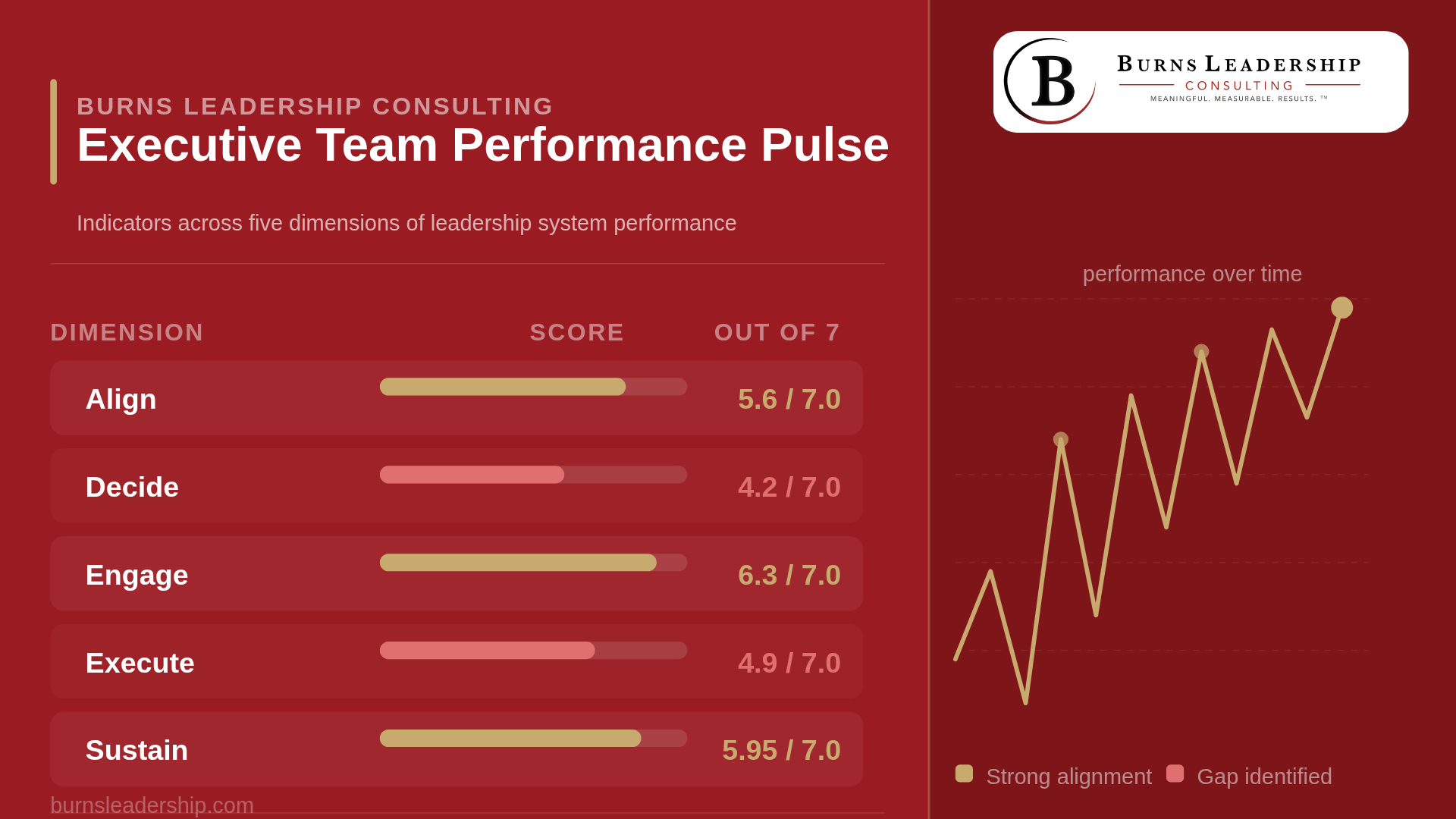
Think of the Leadership Operating System the way you think about the operating system on your phone or computer. It is the underlying structure that makes everything else work. When it is functioning well, performance flows. When it breaks down, even talented people and sound strategies stall. The Pulse measures observable indicators across five dimensions of leadership performance, each of which correlates with the health of the broader Leadership Operating System.
Those five dimensions are:
The indicators the Pulse measures are not the dimensions themselves. They are the observable signals, specifically the things team members can rate and report, that correlate with how well the leadership system is functioning across each dimension. That distinction matters. The Pulse is not a self-report of the system. It is a structured read of the indicators that tell you where the system is strong and where it needs attention.
Bossidy and Charan demonstrated that execution failure is rarely a strategy problem. It is almost always a people and process problem that goes unmeasured and unaddressed. Heifetz, Grashow, and Linsky built on this by showing that many organizational challenges are adaptive rather than technical, requiring leaders to change not just what they do but how they think together. The Leadership Operating System is designed to surface both types of challenges and give teams a path forward.
The Pulse is where that work begins. The debrief, the development work, and the sustained coaching that follow are where the operating system comes to life.
A diagnostic built for any leadership team
The Executive Team Performance Pulse is designed for any leadership team that is serious about performance: executive teams, senior leadership teams, divisional or regional leadership groups, functional leadership teams, and high-potential teams being developed for greater responsibility. If your team makes decisions that affect other people, the Pulse has something to tell you.
It works equally well in organizations of 30 employees or 3,000. The dimensions it measures, including alignment, decision clarity, trust, execution discipline, and sustained learning, are present in every leadership team regardless of size, sector, or stage. Whether your team is navigating rapid growth, managing a transition, or simply trying to operate at a higher level, the Pulse meets you where you are.
Each dimension is assessed through three targeted indicator items, rated on a seven-point scale. The Pulse captures not only the average score for each dimension but also the standard deviation across team members. That dispersion score is often the most revealing number in the report. A low average gets attention. But a high standard deviation tells you something more specific: the team is not in the same conversation.
Teams that score well on average but show high dispersion frequently have a false-consensus problem. Individuals believe alignment exists because the topic has been discussed. But discussion is not the same as shared understanding, and shared understanding is not the same as coordinated action. The Pulse separates these layers and shows leaders exactly where the seams are.
The data is not the outcome. It is the starting point. The work is translating insight into action that changes how the team operates.
What the research tells us about why this matters
The five dimensions of the Leadership Operating System are not arbitrary. Each one is grounded in a substantial body of research on leadership effectiveness and team performance, and the indicators the Pulse measures are designed to reflect that research.
On alignment: McKinsey's Organizational Health Index research found that organizational health, defined as the capacity of an organization to align around a common vision, execute with excellence, and renew itself, predicts long-term performance more reliably than financial metrics alone. Teams that align on direction consistently outperform those that do not, regardless of how strong their individual leaders are.
On decision-making: Eisenhardt and Zbaracki's foundational research on strategic decision-making found that most organizations struggle not because they lack information but because their decision processes are unclear, politicized, or inconsistently applied. That ambiguity slows execution and erodes trust over time.
On engagement and psychological safety: Amy Edmondson's research at Harvard established that teams with high psychological safety, where people feel safe to speak up, raise concerns, and take risks, consistently outperform teams without it, particularly in complex, high-stakes environments. Safety is not a cultural nicety. It is a performance variable, and the Pulse treats it as one.
On execution: Bossidy and Charan argued that the gap between strategy and results is almost always an execution gap, and that closing it requires leaders who are willing to engage in the discipline of follow-through rather than treating strategy as an endpoint. The Execute dimension of the Leadership Operating System is built directly on this premise.
On sustainability: Kegan and Lahey's work on immunity to change revealed that most leadership teams carry deeply held assumptions that work against the very changes they are trying to make. Lasting improvement requires teams to surface and examine those assumptions, not just change their behavior. The Sustain dimension addresses this directly by measuring whether teams are building the capacity to learn and adapt over time.
What organizations are experiencing
Leaders who have taken the Pulse and engaged in a structured debrief consistently report the same experience: they knew something was off, but they could not point to it precisely. The Pulse gives them language, location, and evidence. It turns a vague concern into a workable problem.
In healthcare organizations, leadership teams have used Pulse results to surface misalignment in how different leaders define accountability. What one VP sees as a clear expectation, another sees as ambiguous. The debrief makes that visible in a way that does not assign blame but does create urgency.
In manufacturing, leadership teams have discovered that execution gaps are not always execution failures. Pulse data has revealed that the real issue is a decision-making bottleneck where ownership is unclear and escalation patterns work against speed. Identifying that through data changes the nature of the conversation entirely.
In financial services and architecture, the Pulse has helped leadership teams distinguish between teams that are performing and teams that are performing sustainably. There is a difference, and organizations that invest in the latter tend to retain more talent and weather transitions more effectively.
The debrief process itself generates impact. When a leadership team sees their indicator scores side by side, interpreted through the lens of business outcomes rather than personality or blame, something shifts. Leaders begin to talk about their collective performance as a system rather than a collection of individual contributions. That shift alone changes how the team functions.
When leaders see their data together and connect it to business outcomes, the conversation moves from defensiveness to ownership. That is where the real work begins.
The debrief is where the value lives
Research consistently shows that the highest return from any diagnostic tool comes not from the data itself but from what happens after. Gallup's foundational work on engagement confirms that teams with access to actionable feedback and follow-through outperform those that only collect data. The Pulse is designed with that principle at its center.
The debrief conversation is structured to move from results to reflection to resolution. Leaders leave with a clear picture of what the indicators say, why they matter to their business, and what they are going to do differently. That sequence is not incidental. It is what separates a diagnostic from a development experience.
For teams that track their Pulse over time, the longitudinal data becomes a performance asset. Comparing indicator scores across quarters allows leadership teams to measure the impact of specific interventions, decisions, and structural changes. It answers the question that too few organizations can answer: is our leadership team actually improving, and can we prove it?
Find out where your team actually stands
The Executive Team Performance Pulse takes less than 15 minutes to complete and delivers results your team can act on immediately. Schedule a conversation to learn how it works and whether it is the right fit for where your organization is right now.
Schedule a discovery conversationNo obligation. A direct conversation about what your team needs.
References
Bossidy, L., & Charan, R. (2002). Execution: The discipline of getting things done. Crown Business.
Edmondson, A. C. (2018). The fearless organization. Wiley.
Eisenhardt, K. M., & Zbaracki, M. J. (1992). Strategic decision making. Strategic Management Journal, 13(S2), 17–37.
Heifetz, R. A., Grashow, A., & Linsky, M. (2009). The practice of adaptive leadership. Harvard Business Press.
Katzenbach, J. R., & Smith, D. K. (2015). The wisdom of teams. Harper Business.
Kegan, R., & Lahey, L. L. (2009). Immunity to change. Harvard Business Press.
McKinsey & Company. (2020). Organizational health index: Why it matters. McKinsey Global Institute.
McKinsey & Company. (2024). Cracking the code of team effectiveness. McKinsey Global Institute.