The Leadership Bottleneck Most Leaders Never See
Why This Matters
How leaders operate day-to-day determines whether organizational capability is built or quietly held onto.
Every system has a constraint, the one part that limits what the whole system can produce. Manufacturing leaders know this instinctively. Slow down the narrowest point in a production line and the entire line slows with it, no matter how fast every other station runs. You do not fix a production line by working harder everywhere. You fix it by finding the one place that is actually limiting output.
Leadership works the same way, and it is rarely the org chart or the strategy that creates the constraint. More often, it is leadership itself.
I see this pattern in my coaching work. A leader gets promoted because they were the most capable, most decisive person on the team. They step into a leadership role and keep doing exactly what got them there: making the calls, solving the problems, staying close to everything. For a while, it works. The team hits its numbers. Then growth slows, turnover creeps up among the strongest people, and the leader cannot figure out why, because from where they sit, they are working harder than ever.
The constraint was never effort. It was how leadership operated day to day, and whether that operating pattern grew capability in others or quietly held onto it.
What a Leadership Bottleneck Actually Looks Like
A leadership bottleneck is not a character flaw, and it is not really about any one person. It is a pattern where leadership concentrates capability instead of multiplying it. Decisions stay with the same few people. Development happens if there is time left over, not as core work. The next layer of leaders never quite gets ready.
From the inside, this rarely looks like a problem. It looks like being responsible. A leader who makes every call, fills every silence, and stays the smartest person in the room usually believes that is what strong leadership looks like. The organization around them experiences it differently. Capability stops spreading. It just accumulates at the top, and everyone below that leader gets a little smaller to fit around them.
Why This Matters for Performance, Not Just Culture
It is tempting to file this under culture, something nice to fix once the numbers are healthy. The data does not support treating it as optional. A leadership bottleneck shows up directly in performance: slower decisions because everything routes through one person, thinner succession benches, and higher turnover among the exact people an organization can least afford to lose, the ones capable enough to notice they are not growing.
It shows up in organizational health too. Teams either come alive around a leader, contributing their full thinking and growing into more responsibility, or they quietly shrink to fit whatever that leader is comfortable delegating. Over time, the second pattern becomes self-reinforcing. The people most capable of relieving the bottleneck are the first to leave it, because they can see it clearly and they have other options.
Performance and organizational health are not two separate conversations here. They are the same conversation, measured two different ways.
The Five Places Leadership Capability Gets Stuck
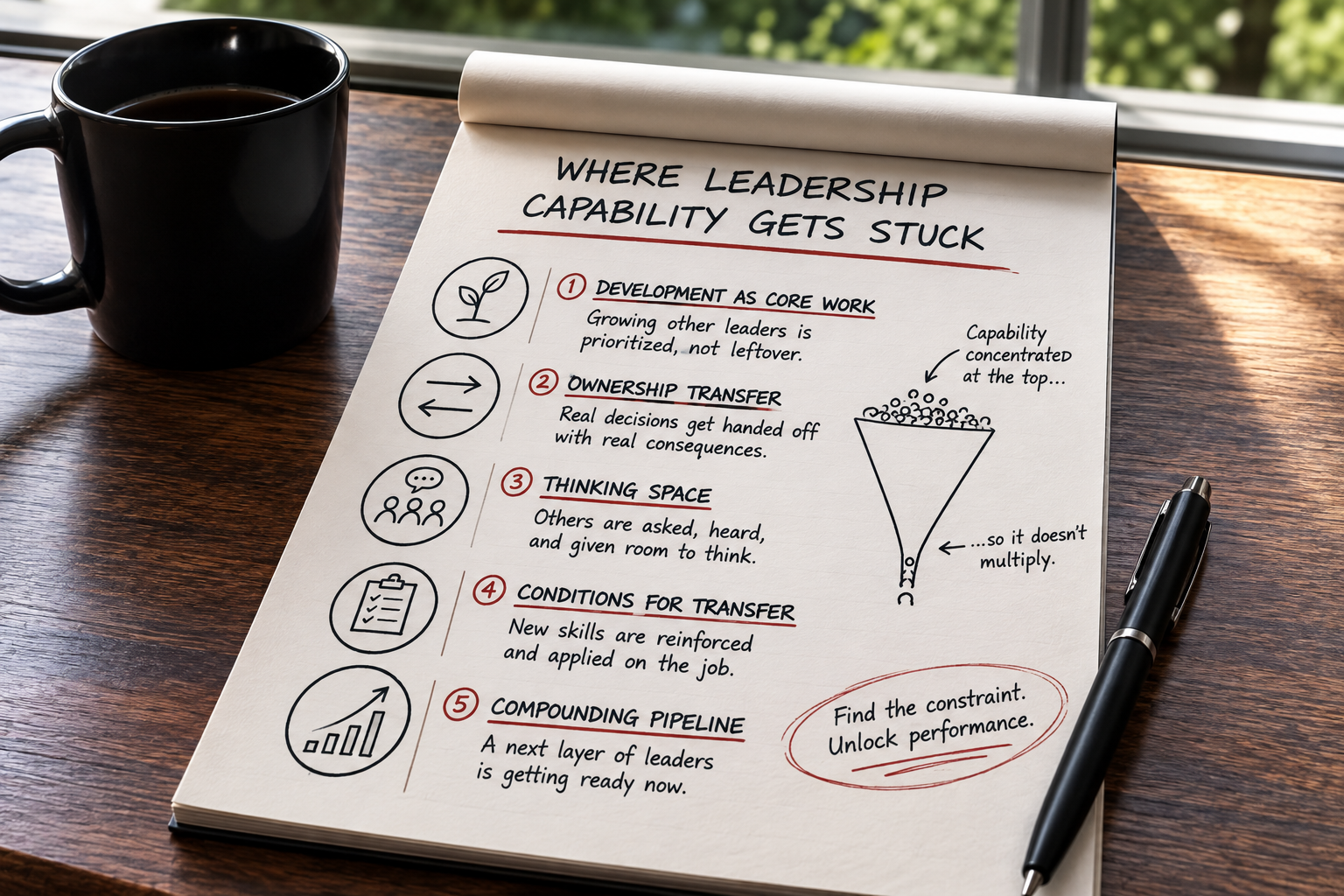
Through years of coaching leaders and leadership teams, I have found the constraint almost always concentrates in one of five places.
Development as Core Work. Leaders either treat growing other leaders as real work, budgeted time and real attention, or as whatever is left over once the actual job is done. When it is the latter, development conversations get bumped for the third meeting in a row, and everyone quietly learns what actually gets prioritized.
Ownership Transfer. Leaders either hand off real decisions, the ones with real consequences attached, or they hand off tasks while quietly staying involved in everything that matters. Letting someone run the interview is not the same as letting them make the hiring call.
Thinking Space. Leaders either make room for others to think and contribute, asking more than they tell, or they fill every gap themselves, leaving little room for anyone else's judgment to develop. A team that has never been asked a hard question rarely learns how to answer one.
Conditions for Transfer. New skills either get reinforced and applied after a leader learns them, or they fade once the workshop or the coaching engagement ends. Development that is not reinforced on the job is development that mostly evaporates within a few weeks.
Compounding Pipeline. A leadership team is either building a next layer of ready leaders, or it is quietly dependent on the same few people it has always depended on. This is the dimension that shows up hardest in a crisis, when a key leader steps away and the organization discovers, all at once, who was actually ready.
Most leadership teams are not weak across all five. They are strong in three or four and constrained in one, and that one dimension is usually the reason performance plateaus even when everything else looks solid on paper.
Why Most Leaders Can't See Their Own Constraint
This is the part that makes the pattern hard to fix on your own. The leaders producing a bottleneck almost never recognize it, because the behaviors that create it are the same behaviors that got them promoted in the first place: being decisive, being available, being the person who steps in when something goes sideways. Those instincts serve a leader well in an individual contributor role, and even well in the early days of leading a team.
Left unchecked at the top of a team for years, though, those same instincts become the ceiling everyone else works under. The leader keeps doing what has always worked. The team keeps adapting around it. Nobody names it, because naming it would mean questioning the exact strengths that built the leader's credibility in the first place.
Awareness has to come from somewhere outside the pattern itself. That usually means an honest, structured look at how leadership actually operates, not how it intends to operate, and not how it looked five years ago before the team doubled in size.
Finding Your Leverage Point
Not every dimension carries equal weight. In most organizations, one dimension scores meaningfully lower than the rest, and that dimension is the leverage point, the place worth addressing first because closing that gap tends to lift everything else with it. A leadership team that is strong on ownership transfer and thinking space but weak on compounding pipeline does not need a broad leadership development overhaul. It needs a plan for who is next, and it needs it built now rather than after someone leaves.
Sometimes leadership is genuinely even across all five dimensions, and no single one stands out as the primary constraint. That is useful information too. It means the work is less about one fix and more about building the practice of development into how the whole team leads, consistently, rather than searching for a single lever that does not exist yet.
To help leaders see this clearly, I built a short self-check called The Constraint Check. Fifteen statements, about five minutes, and a structured read on where your leadership is multiplying capability and where it is quietly constraining it, dimension by dimension, with a leverage point identified when one emerges.
Closing the Gap: What to Do Next
Naming the constraint is the starting point, not the finish line. A few places to begin, depending on where your own leadership tends to lean:
If development keeps losing to whatever feels urgent, put one real development conversation on the calendar this week, not "when things calm down." Things rarely calm down on their own.
If you notice you are still the one making calls your team is capable of making, pick one real decision, not a task, and hand it off completely this month. Let the outcome belong to someone else, including if it does not go exactly how you would have done it.
If meetings tend to run through you, try asking one more question than you normally would before offering your own answer. Small shift, and it changes what a team learns to expect from itself over time.
None of these fix a constraint by themselves. They start building the muscle that does.