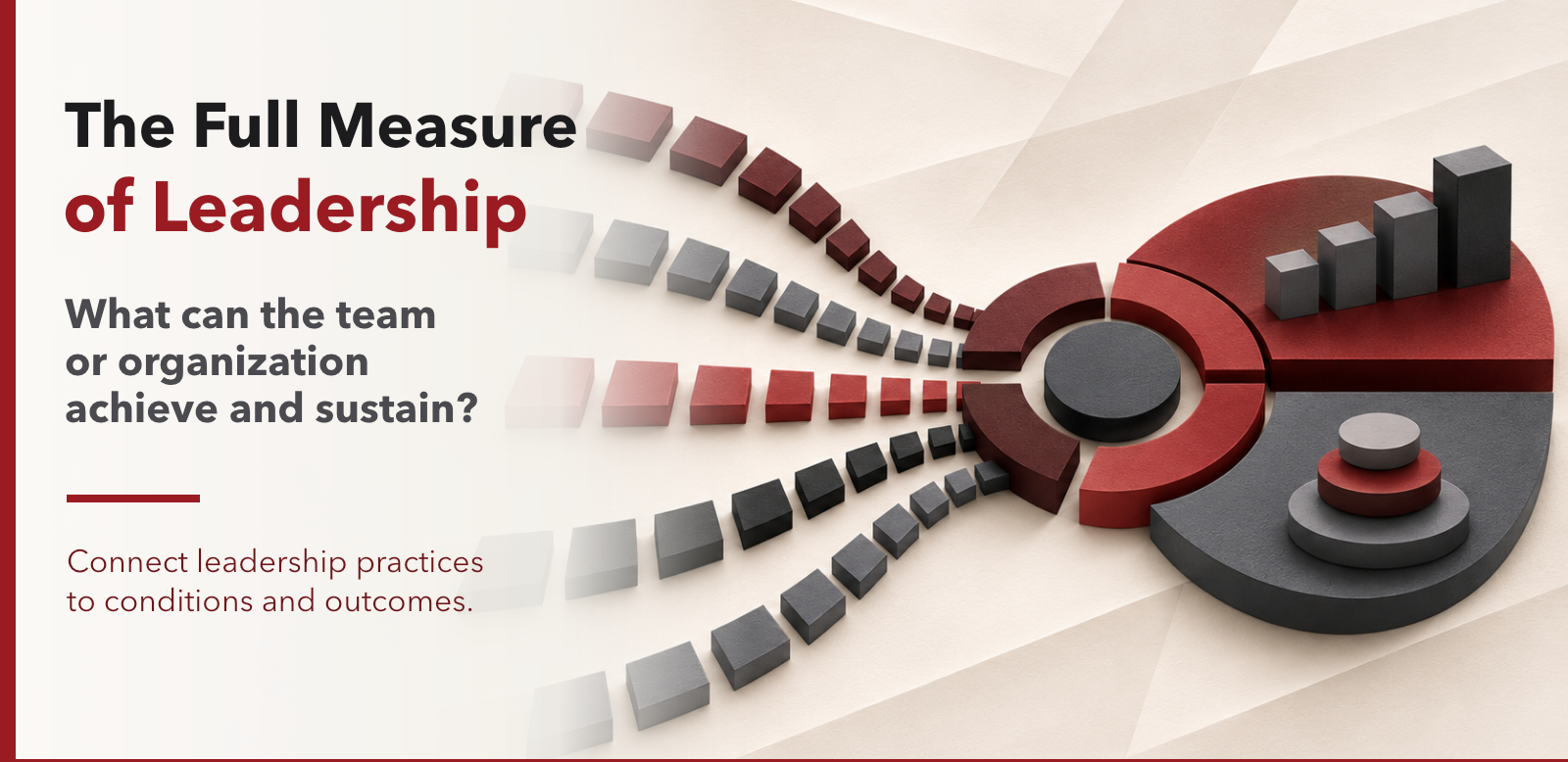
We learn a great deal about leaders by listening to how people experience them. Trust, credibility, clarity, and respect all matter. They shape whether people will follow, speak honestly, and stay engaged when the work becomes difficult.
We learn something more when we examine what the team or organization can achieve.
That distinction is especially important for senior leaders. Our roles carry responsibility for business results, but also for the conditions that make those results possible. We influence how priorities become decisions, how commitments hold, how people raise difficult issues, and whether capacity grows or erodes under pressure. Leadership effectiveness must include both workplace performance and organizational health.
Reputation is important, but incomplete
Kaiser, Hogan, and Craig reviewed the leadership literature and found that much of it tells us how individual managers are regarded. That is useful, but it does not fully explain how leaders affect collective and organizational performance. They proposed evaluating leadership in relation to the performance of the team or organization for which the leader is responsible (Kaiser et al., 2008).
A group is not automatically a team
That language deserves some precision. Kaiser, Hogan, and Craig cast a wide net. They consider the performance of groups, teams, and organizations because leaders are responsible for many different kinds of collective work. A team, however, is a particular kind of group.
Curphy and Hogan distinguish teams by common goals, interdependent work, joint accountability, and a shared fate. A group may be healthy and productive even when its members perform largely independent work and are accountable for individual outcomes. One is not inherently better than the other. The work should determine which structure is needed (Curphy, 2012; Kozlowski & Ilgen, 2006).
Before we measure a leader’s effect, then, we should ask what these people must accomplish together. If success requires coordination and members win or lose together, team performance and team health are appropriate measures. If the work is primarily independent, group or organizational outcomes and the conditions the leader creates may be more accurate. Precision matters because we should not expect teamwork from work that was never designed to be interdependent.
This does not mean we reduce leadership to a short-term number. A team or organization can hit a quarterly target while burning out its strongest people, avoiding necessary disagreement, or depending on the leader for every consequential decision. Those results may look good today while weakening its ability to perform tomorrow.
It also does not mean every result belongs solely to the leader. Markets change. Resources tighten. Unexpected events reshape the work. Leadership is one influence inside a larger system.
The more useful conclusion is that we need a fuller view. How people experience us matters. What the team or organization produces matters. The health and capacity people build while producing it matters too.
Look for the leadership effect in the work
Senior leaders already carry a great deal. The goal is not to add another dashboard or imply that every problem reflects a personal failure. The goal is to make the connection between leadership practice and collective performance clear enough that we can learn from it.
Start with one outcome that matters to the team or organization. It may be an operating result, a strategic milestone, customer responsiveness, retention in a critical role, or the team’s ability to make decisions without unnecessary escalation. Choose the outcome because it matters to the business, not because it is easy to count.
Then name the leadership practice that should influence it. If the outcome depends on cross-functional execution, the practice may be clarifying the shared priority and making tradeoffs visible. If decisions keep returning to the top, the practice may be defining who decides and when escalation is warranted. If commitments drift, the practice may be a consistent review rhythm with clear owners and dates.
Finally, identify evidence close enough to the work that the people involved can see and use it. Are fewer decisions coming back for clarification? Are risks surfacing earlier? Are commitments completed by the agreed date? Is the next level of leadership carrying more responsibility with confidence? These are not perfect measures, but they create a practical learning loop.
Measure conditions as well as results
Leadership outcomes often appear after the conditions that produce them. If we wait only for a lagging business result, we may miss the opportunity to adjust while the work is unfolding.
The five LeadershipPulse™ conditions I leverage offer one way to watch those leading indicators. ALIGN asks whether leaders make decisions and allocate resources consistent with what matters most. DECIDE examines whether the right decisions happen at the right level and hold. ENGAGE looks for honest conversations and feedback that moves in every direction. EXECUTE makes commitments and follow-through visible. SUSTAIN protects capacity while developing the next leaders.
No single condition proves that a leader is effective. Together, they help us see how leadership practices shape the environment in which people work. They also connect the human experience of leadership with the operating outcomes senior leaders must deliver.
For example, a senior leader working to improve execution might track the percentage of priority commitments completed by the agreed date. The team could also review where work stalled and whether the cause involved unclear ownership, delayed decisions, or limited capacity. The measure does more than judge performance. It helps leaders and team members learn what to do next.
Use the measure for development, not theater
Measurement becomes less useful when leaders feel pressure to produce a perfect story. We need enough trust to examine the evidence honestly, especially when the outcome disappoints us.
A good monthly review can use four questions:
What outcome are we trying to influence?
Which leadership practice should move it?
What evidence changed this month?
What will we adjust before the next review?
The conversation should remain developmental. We are not trying to claim credit for every positive result or assign blame for every setback. We are testing whether our leadership practices are creating the conditions the people and the work require.
Over time, this discipline strengthens coaching and succession decisions too. A leader may be well liked and highly capable, but the fuller question is whether the people around that leader are becoming clearer, more accountable, and more able to perform. We should be able to see growth in the leader and in the collective capacity around that leader.
The question worth carrying
Most of us want to lead well. We want people to trust us, and we want the work to make a difference. Those aims belong together.
The question is not only, “How am I experienced as a leader?” It is also, “What are the people I lead able to accomplish, sustain, and become because of how I lead?”
That question respects the weight senior leaders carry while keeping the focus on what matters most. It connects insight to action and action to measurement. It also gives us a practical way to amplify the leadership practices that help people and organizations truly thrive.
References
Curphy, G. J. (2012, June 18). Important differences between groups and teams. Hogan Assessments.
Kaiser, R. B., Hogan, R., & Craig, S. B. (2008). Leadership and the fate of organizations. American Psychologist, 63(2), 96–110.
Kozlowski, S. W. J., & Ilgen, D. R. (2006). Enhancing the effectiveness of work groups and teams. Psychological Science in the Public Interest, 7(3), 77–124.
LeadershipPulse™ examines five conditions that help leadership produce meaningful, sustainable results: ALIGN, DECIDE, ENGAGE, EXECUTE, and SUSTAIN. It helps leaders see where their operating environment supports performance and where unclear priorities, decision rights, engagement, follow-through, or limited capacity may be creating friction.
The goal is not simply another score. It is clearer evidence about what to strengthen, what to do next, and what to measure.
If you would like to explore what these conditions look like in your organization, connect with me for a conversation.