Leadership Influence Is More Than Getting People to Follow
How senior leaders build the credibility, relationships, and organizational capability needed to make a difference
We often associate leadership influence with the ability to persuade people, gain support for an idea, or move others toward a particular decision. Those are important aspects of influence, but for senior leaders, the implications extend much further. Our influence shapes how people interpret priorities, respond to uncertainty, engage in difficult conversations, make decisions, and work together. It affects whether people take ownership, share what they are thinking, and contribute their best efforts to the organization's success.
Some of that influence is intentional. Much of it develops through the repeated experience people have with our leadership. We may believe we are encouraging ownership while our behavior communicates that important decisions still need our approval. We may believe we welcome disagreement while people have learned to be careful about what they share. We may consider ourselves approachable while others experience us as too busy or distracted to engage. The gap between our intentions and how others experience us deserves attention because our influence is shaped as much by what people experience as by what we intend.
Authority and Influence Are Different
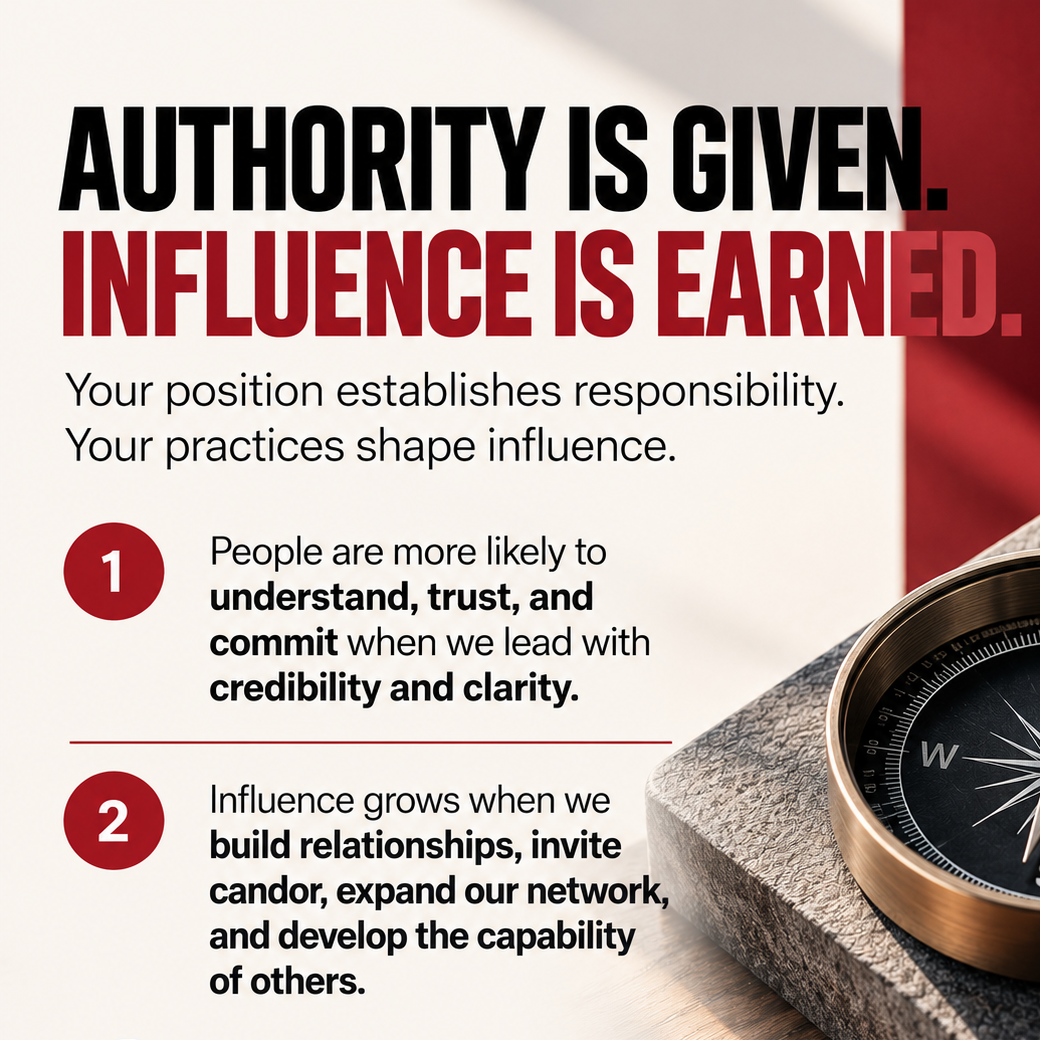
A leadership position provides legitimate authority. We have responsibilities, decision rights, and expectations that accompany the role. We can establish priorities, allocate resources, make decisions, and hold people accountable. These responsibilities are essential, but having the authority to direct work does not necessarily mean we have developed the influence needed to create genuine commitment, collaboration, and sustained performance.
Research by French and Raven (1959) established an important foundation for understanding different sources of social power. Their work distinguished legitimate power, which comes from formal authority, from other sources, including expert power and referent power. The distinction is particularly relevant for senior leaders because positional authority can secure compliance without necessarily creating commitment. A team may follow a direction because the CEO made the decision. That does not automatically mean people understand the reasoning, believe their concerns were considered, or have developed the judgment needed to make similar decisions themselves.
As our responsibilities grow, relying primarily on authority becomes increasingly limiting. We cannot personally direct every decision, manage every relationship, or resolve every challenge across the organization. We need people who understand the organization's priorities, exercise sound judgment, collaborate across boundaries, and take responsibility for results. Our influence becomes more valuable when it strengthens those capabilities rather than increasing people's dependence on us.
Credibility and Clarity Create a Foundation
Credibility develops through competence, consistency, judgment, and integrity. People observe whether our actions align with our words. They notice how we respond when circumstances become difficult, whether we acknowledge mistakes, and whether we apply expectations consistently. They also pay attention to the quality of our decisions and whether we demonstrate an understanding of the work and the people affected by those decisions. Credibility does not require having every answer. It requires giving people reason to trust how we approach the responsibilities we carry.
Clarity is equally important. Senior leaders routinely make decisions involving competing priorities, incomplete information, and difficult tradeoffs. When we fail to explain what matters most or how decisions should be made, people fill those gaps themselves. One leader prioritizes speed, another protects margin, and a third focuses on customer experience. Each may believe they are acting in the organization's best interest, yet their teams receive competing signals about what matters most. The result can be unnecessary conflict, delayed decisions, and frustration across the organization.
Influence includes helping people understand how priorities fit together, what outcomes matter, and what should guide their decisions. This requires more than communicating a strategy or repeating organizational objectives. It means creating opportunities for discussion, surfacing different interpretations, and ensuring that leaders understand what alignment looks like in practice. When credibility and clarity work together, people have greater confidence in both the direction and the leadership behind it.
Connection and Candor Determine What We Learn
Our relationships influence the quality of information available to us. As leaders move into more senior roles, people may become increasingly selective about what they share. Some want to demonstrate confidence. Others want to avoid disagreement or protect their reputation. Still others have learned from previous experiences that raising concerns can carry personal or professional risk. This creates a significant leadership challenge. We can hold considerable authority while having an incomplete understanding of what is happening around us.
Amy Edmondson's (1999) research on psychological safety provides a useful perspective. Her work connects team psychological safety with learning behavior, including the willingness to speak up, acknowledge mistakes, and raise concerns. For leaders, the implication is practical. If we want people to share what we need to hear, we must pay attention to how we respond when they do. Our reactions to disagreement, unexpected problems, or disappointing results teach people whether openness is genuinely valued.
Connection creates opportunities for understanding, while candor makes those relationships more useful. Neither develops through statements of intent alone. They develop through repeated interactions where people experience respect, openness, and appropriate accountability. We strengthen our influence when people trust that they can challenge our thinking without damaging the relationship and when we demonstrate a willingness to reconsider our perspective. The objective is not to create agreement. It is to create the conditions for better thinking, stronger decisions, and shared responsibility.
Our Network Influences What Becomes Possible
Senior leaders rarely accomplish important work through their direct reports alone. Organizational performance depends on relationships across functions, teams, customers, boards, and external stakeholders. The quality of those relationships affects access to information, coordination, problem-solving, and the organization's ability to respond to changing conditions. A leader may have a clear organizational chart and still misunderstand how decisions actually move through the business or whose perspectives influence whether an initiative succeeds.
Balkundi and Kilduff (2006) examined leadership through a social network perspective, emphasizing the importance of relationships and network structures in understanding leadership processes. Their work reinforces the value of looking beyond formal reporting relationships to understand how information, influence, and coordination move through organizations. For senior leaders, developing influence requires understanding those relationships and investing in them intentionally.
This becomes particularly important during leadership transitions. A new leader may inherit positional authority immediately, but the relationships needed to exercise that authority effectively take time to develop. Learning who influences decisions, where collaboration is strong, and where organizational boundaries create friction can be as important as understanding the formal structure. The goal is not simply to expand our personal network. It is to develop relationships that improve the organization's ability to coordinate its work and accomplish shared objectives.
The Strongest Influence Develops Capability in Others
There is another dimension of leadership influence that deserves more attention: What happens to the people and organization because of our leadership? Do people become better equipped to make decisions? Do teams develop stronger working relationships? Does the organization become more capable of performing without our direct involvement? Or does our effectiveness depend primarily on our personal presence, expertise, and willingness to intervene?
Many of the strengths that help us advance into senior leadership can become limitations if we continue relying on them in the same ways. Our ability to solve problems may lead us to intervene too quickly. Our high standards may cause us to retain decisions others are capable of making. Our responsiveness may unintentionally teach people to seek our direction rather than exercise their own judgment. These behaviors often come from positive intentions, yet they can limit the development of others and create unnecessary dependence on the leader.
As organizational complexity grows, we cannot continue increasing our personal involvement in every important issue. Effective leadership requires helping others develop the judgment, confidence, and capability to take responsibility for outcomes. We accomplish this through clear expectations, meaningful delegation, coaching, feedback, and opportunities to make decisions and learn from experience. Our influence becomes more sustainable when it increases the effectiveness of others and strengthens the organization's capacity to perform.
This is where leadership influence extends beyond individual effectiveness. We are not simply influencing people to accomplish today's priorities. We are helping develop the capability needed to address tomorrow's challenges. That distinction is important for leaders who want to create meaningful, measurable results while building a healthier and more effective organization.
Six Dimensions of Leadership Influence
These considerations led me to develop the Leadership Influence Score, a practical framework for examining how our leadership may be experienced and where more intentional practices could make a difference. The framework considers six dimensions: Credibility, Clarity, Connection, Candor, Network, and Multiply. Each represents an important aspect of how we influence people and organizational outcomes.
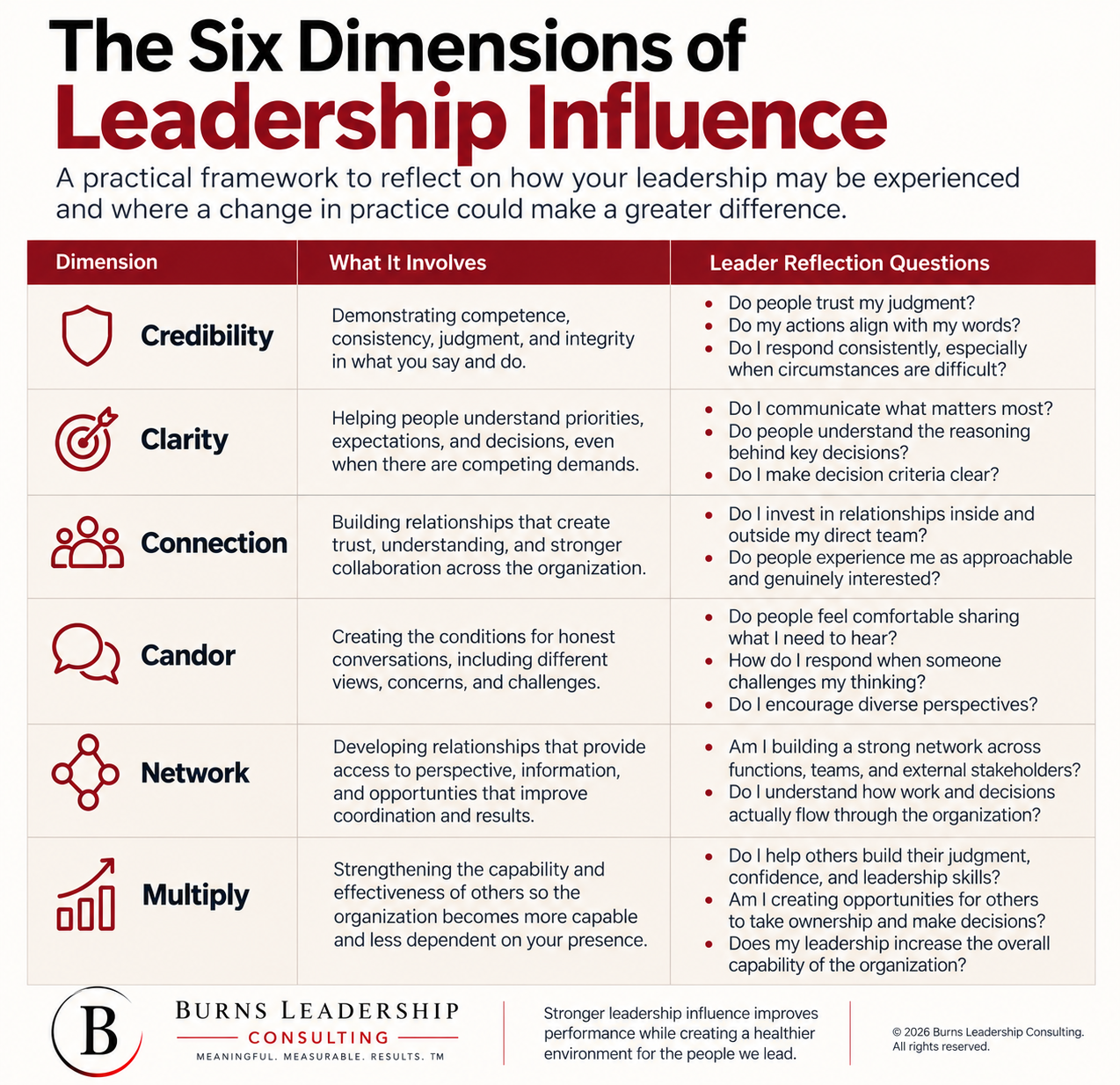
The six dimensions provide a structure for reflection rather than a label or judgment about a leader's effectiveness. A senior leader may have considerable credibility but struggle to create clarity across the organization. Another may build strong relationships while avoiding difficult conversations. Still another may be highly effective personally but have difficulty developing capability in others. These patterns are worth examining because leadership effectiveness rarely depends on a single strength or behavior.
The Leadership Influence Score is intended as a practical reflection tool, not a scientifically validated assessment of leadership effectiveness. Its value comes from helping us consider how others may experience our leadership, recognize opportunities for improvement, and identify specific practices that could strengthen our influence.
From Awareness to Practice
Leadership assessments and reflection tools can create valuable awareness, but awareness alone does not change how we lead. The more important question is what we do with what we learn. If clarity is an opportunity, we might focus on making decision criteria more explicit and checking whether leaders share the same understanding of organizational priorities. If candor needs attention, we might examine how we respond when someone challenges our perspective or raises an uncomfortable concern. If developing others is the priority, we might reconsider which decisions we continue making that others could own.
These are practical leadership behaviors we can observe, discuss, and improve. We can seek feedback from people who experience our leadership, identify a small number of practices to change, and examine whether those changes are producing better outcomes. Over time, the evidence may appear in stronger decision-making, more effective collaboration, greater ownership, fewer recurring issues, and improved organizational performance. The objective is not to achieve a perfect score. It is to become more intentional about how we influence the people and work that matter most.
Leadership influence is not simply about getting people to follow our direction. It is about creating the conditions where people can contribute their best thinking, take responsibility, work effectively together, and accomplish meaningful results. When we strengthen our influence in these ways, we do more than improve our personal effectiveness. We help build organizations where performance and organizational health reinforce one another.
How Are People Experiencing Your Leadership Influence?
Most of us have a reasonably clear understanding of what we intend to accomplish as leaders. We may be less certain about how our leadership is actually experienced by others or where our influence could be more effective.
The Leadership Influence Score offers an opportunity to reflect on six dimensions of influence and identify where a change in leadership practice could make a meaningful difference.
References
French, J. R. P., Jr., & Raven, B. (1959). The bases of social power. In D. Cartwright (Ed.), Studies in Social Power. University of Michigan.
Edmondson, A. (1999). Psychological safety and learning behavior in work teams. Administrative Science Quarterly, 44(2), 350–383.
Balkundi, P., & Kilduff, M. (2006). The ties that lead: A social network approach to leadership. The Leadership Quarterly, 17(4), 419–439.